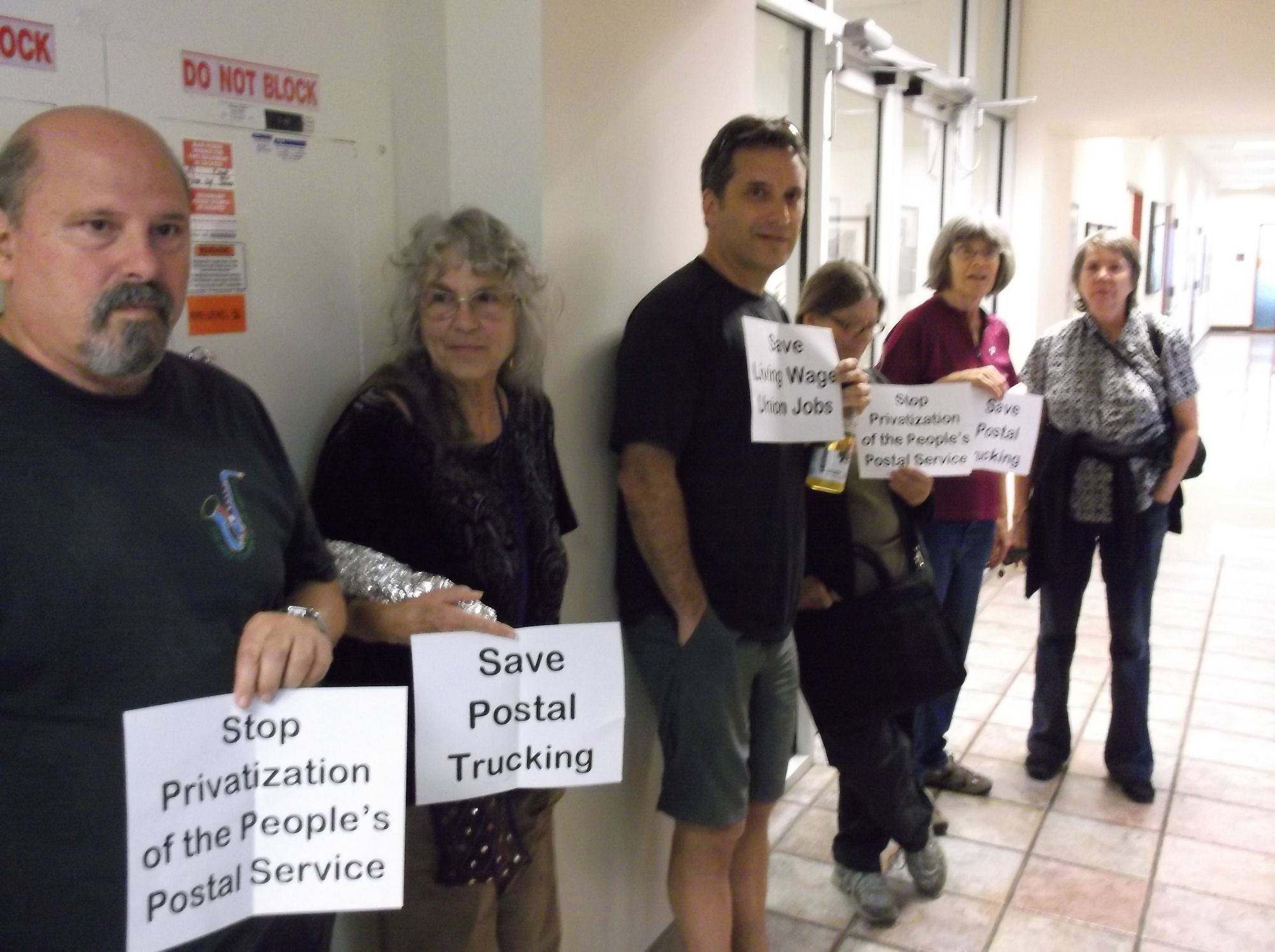
Below is a tool you can use to find your congressmans phone number. Please call and ask for co sponsorship on this bill. Also ask for his support through the committee process and forward to passage in the House of Representatives. http://www.congress.org/congressorg/dbq/officials/.
We need your cards and letters soon! If all the people who receive this email mail us a greeting card or postcard. We will share them with our elected officials and we will get the legislation we want to"SAVE OUR POST OFFICE"! This will be irifutable proof our post office isn't broken and people care about it and use it.
SAVE OUR POST OFFICE Post Office Box 5041 Terre Haute, IN 47805
For our facebook followers. You can follow our activities at the following page. We share information about our petitions, pictures, polls and news articles about our activities. http://www.facebook.com/saveourpostoffice
Guest Viewpoint Step by step, Postal Service is being dismantled
By Jim Kubli, Gary Jarvis, and Shelley Jensen
Published: February 24, 2013 12:00AM, Midnight, Feb. 24
Abruptly, starting on Jan. 29, priority and first-class package mail coming into the Eugene-Springfield area has been rerouted to Portland for sorting. All our mail of this type is now delayed by one day in Portland. The next step is to move outgoing priority processing to Portland as well. Combined with the proposed reduction of delivery days from six to five, some deliveries will be delayed for up to four days.
This is not about saving money; this is about the systematic and incremental dismantling of the U.S. Postal Service. Some members of Congress, the postmaster general and Board of Governors are essentially boiling the frog slowly, claiming to be streamlining and cutting non-essential service.
It appears that full privatization is the goal. Once the Postal Service bureaucrats and some congressional representatives weaken our Postal Service infrastructure by shuttering facilities and selling off valuable real estate, the service will be destroyed.
It does not take much imagination to see that we will end up with a privatized delivery system that focuses on profit over public service.
The American people own the current Postal Service and the benefits that go with that ownership. Once our Postal Service is appropriated by private entities that prioritize profit, reasonable rates for first-class service will no longer exist — nor will the ability to deliver a letter to anywhere in the country for a single price.
Rep. Peter DeFazio has called for the firing of Postmaster General Patrick Donahoe. Recently the National Association of Letter Carriers called for his resignation.
Do you want your Postal Service, planned and placed in operation by Benjamin Franklin, to be given away to for-profit corporations? The USPS gives special consideration to and is the largest civilian employer of veterans. About 30 percent of postal workers are vets. Postal workers take an oath to protect the “sanctity of the mail.” USPS guarantees the privacy and security of your mail and delivers your ballot in Oregon.
Myth No. 1: The USPS uses tax money.
Fact: The USPS uses no tax money.
Myth No. 2: The USPS is losing money because fewer people are using it.
Fact: The Bush-era Postal Accountability Enhancement Act of 2006 required 75 years’ worth of prefunding of retiree health care costs, something required of no other governmental agency or business. As a separate issue, it is estimated that the postal service has overfunded the Civil Service Retirement System by $50 billion to $75 billion and the Federal Employees Retirement System by $11 billion.
Fact: The number of packages being delivered daily by USPS has been rising.
Fact: FedEx and UPS use USPS to deliver packages to locations that are not profitable. For 46 cents, your constitutionally guaranteed USPS will deliver a first-class letter to anywhere in the country.
Closure by stealth is defined by Wikipedia as “the deliberate downgrading of a service by the management or owners with the intention of driving away users or customers. The aim is to make the service uneconomical, and thereby justify its closure or withdrawal. It is most widely used in the case of government-regulated services.” This type of action is known as shrinking government to the size where it can be drowned it in a bathtub.
Three types of evidence for closure by stealth of our postal service can be found here in Lane County. First, cuts in services affect all of us. Reducing delivery to five days is part of Postal Service leaders’ death spiral approach to solving budget problems.
Current service standards require that first class mail within a ZIP code prefix (like 974) be delivered overnight. Until last summer delivery between 974 and 973 was overnight, but last summer that was degraded to two days.
Second, cuts dramatically affect rural communities. Examples include reduction of post office hours in rural post offices to two, four and six hours; privatization of labor in rural post offices; and removal of home mail boxes, making folks drive to central locations to pick up their mail.
Third, cuts affect regions. USPS leaders intend to close the Gateway Mail Processing Center in Springfield; all mail in our region will be trucked to Portland for sorting and driven back down for delivery.
Many Eugene area citizens thought that the closure plan had been halted due to strong public opposition at the Dec. 27, 2011, hearing. Unfortunately, closure by stealth of the Gateway center never stopped and is under way in full force now.
There will be an opportunity for action on April 13 at the main Eugene post office, 520 Willamette St.
Jim Kubli is president of Eugene Area Local No. 679 of the American Postal Workers Union, AFL-CIO. Gary Jarvis is director of research and education for Local No. 679, and its former president and executive vice president. Shelley Jensen is co-chairwoman of the Eugene/Springfield Solidarity Network.
The Postal Service has a survey on ending Saturday delivery:
February 15, 2013
The Postal Service has just released the results of a survey it commissioned on its plan to end Saturday delivery. The Postal Servicepress release says the survey shows that 80 percent of Americans support the new delivery schedule.
Before you take that conclusion very seriously, there are a few things you should know aboutthe new survey.
First, the survey was “fielded online.” That means that the people who most depend on the Postal Service and Saturday delivery — those who aren’t online all the time, like seniors and people in rural areas without good broadband — were excluded from participating in the survey.
Second, the Postal Service says that the survey used “a blended sample of panel and non-panel.” That means some of the people surveyed were recruited to participate. The Postal Service doesn’t provide any information about how the recruitment was done or who was selected to participate or what portion of the thousand people surveyed was pre-selected. One can only imagine how the selection process might have skewed the results.
Third, and perhaps most importantly, the survey includes questions that are framed in ways that inevitably affect how people responded. The first question on the survey, for example, is: “Before today, do you recall hearing anything about the financial losses that the Postal Service experienced last year, of approximately $15.9 billion?”
The survey thus begins by presenting the participants with a huge deficit number, which undoubtedly inclines the average person to favor cost-cutting measures like ending Saturday delivery.
Subsequent questions on the survey are even more likely to bias the results. One question says: “After learning that this change will ensure that the Postal Service does not experience an interruption in service, to what extent do you support the decision of the Postal Service to begin delivering mail five days per week and packages six days per week, including continuing package delivery on Saturdays?”
Another question says: “After learning that this change will ensure that the Postal Service does NOT have to raise the prices of mail service or package delivery in the near future, to what extent do you support the decision of the Postal Service to begin delivering mail five days per week?”
The next question says: “After learning that this change will ensure that the Postal Service does NOT become a burden on U.S. taxpayers, to what extent do you support the decision of the Postal Service to begin delivering mail five days per week?"
The Postal Service thus basically tells survey participants, "If we don’t end Saturday delivery, we may need to raise postage raises, or we might have to look for a bailout from the taxpayer, or we may not be able to deliver the mail at all." These are obviously scare tactics designed to elicit the responses the Postal Service wants from the survey. They are not unbiased questions intended to get useful survey results.
The survey was conducted by IPSOS, a global market research company headquartered in Paris. The survey describes IPSOS as “a leading independent, publicly-listed market research company.” The survey is so patently biased, one has to wonder how IPSOS could have agreed to conduct it.
Perhaps it would be useful if the Postal Service conducted another survey that provided some actual facts about the context for its plan to end Saturday delivery — something that explains the causes for the deficit, the problems with the plan, and so on. Since the Postal Service is unlikely to commission such a study, Save the Post Office is conducting its own.
Like the IPSOS survey, ours is online, so the results are skewed toward Internet users, but we've tried to set up the questions in a more informative and objective way than the Postal Service did.
If you have a moment, please take the survey, and then click on the link to see the results so far. We'll be sure to share them with the Postal Service.
If you want to share the survey, email a link to this page (here) or go directly to the survey on Google Docs,here, and send that page around. (If the survey isn't appearing below, try refreshing your browser.)
Letter Carriers Call for Ouster of Postmaster General
Postal employees, Rep. Danny Davis say Postmaster General Patrick Donahoe doesn't doesn't have the authority shutter Saturday delivery of mail
Nearly 200 letter carriers and their supporters gathered at the Branch 11 headquarters of the National Association of Letter Carriers, at 3850 S. Wabash Ave., on Wednesday.
So do weNone too pleased with the United States Postal Service's move to shutter Saturday delivery, nearly 200 letter carriers on Wednesday evening rallied in Chicago and called for Postmaster General Patrick Donahoe to step down.
"Donahoe has got to go!" postal workers shouted the Branch 11 headquarters of the National Association of Letter Carriers, at 3850 S. Wabash Ave.
"Eighty thousand jobs could be lost! We can't let that happen," Branch 11 President Mack Julion told the carriers and their supporters.
Rep. Danny Davis, a former postal worker himself, flew in from Washington to speak to the crowd.
"Something had to give," he said. "We've known it for years, but this seems like a sneak attack. We didn't know this was going to happen today."
Post offices would still remain open on Saturdays under the plan, which is slated to start in August.
But it wasn't immediately clear if the USPS can even make the move without congressional approval. Congress has banned five-day delivery under an appropriations bill, but since the federal government is now operating under a temporary spending measure Donahoe said he believes he has the authority to act alone.
"The House of Representatives has refused to seriously solve the crisis," Davis told the union workers. "This is about taking America backward. This is about busting unions."
"We urge Congress to develop a real reform plan that gives the Postal Service the freedom to grow and innovate in the digital area," the organization said.
Portland Communities and Postal Workers United 01/15/13 meeting (@ Peace House)
Notes by Jamie P (send additions and corrections)
Present: Jamie P(chair & notes), Jim C, Kevin C, Cass M, Ben P, John S, Jordan M, Willie G, Tom R, Sue P
ATTACHMENTS – March 17 handbill
- Tasks & assignments (draft) for March 17
1.Update on postal crisis -- Last quarter the USPS posted a surplus, which just shows that the financial crisis is manufactured.
81 mail processing plants (20% of total) and many of the large ones, are scheduled for closure come February, many on Feb. 23. The Oregon plants (Salem, Springfield, Bend & Pendleton) are scheduled for January, 2014 closure, but the Postal Board of Governors has directed the Postmaster General to “accelerate the cuts.” Kevin thinks the Oregon plants will be “consolidated” this summer. CPWU nationally is trying to reach out and encourage those union locals (and communities) to launch a fight back. 48 plants (10%) went down this summer, bring the total to 70 in the past two years (eliminating 60,000 jobs).
Further cuts & closures to rural post offices are moving forward rapidly. Nearly half the 13,000 slated for cuts in the 2012 – 2014 POStplan have already had their full-time postmaster position eliminated and their service hours reduced 25 – 75%. We do not know how many Oregon offices have been hit – 124 are on the list. The Rural Organizing Project continues to help communities resist, especially through turnout at USPS/community meetings.
Portland postal workers are more understaffed than ever. Letter carriers are out after 8 & 9pm. Clerks are stuck with lines out the door. The new letter carrier union contract (“arbitration award”) creates a new, lower paid City Carrier Assistant position (with a 27% pay cut for Transitional Employees converting to CCAs) which will have a career path, if they pass the written test. With a CCA’s right to “bid” on routes and a contractual mandate to fill vacant routes, the understaffing problem should be eased somewhat in the near future, however over 100 routes are still being “withheld” for “excessing” from the Salem plant.
2. Sunday March 17th – March and Rally “In the Spirit of 1970” (Anniversary of the Great Postal Strike) Restore Jobs, Restore Service! Stop Closures, Cuts, and Delay of the Mail! Fix Postal Finances without Taxes!
We agreed to help organize a local action in response to the national call by Communities and Postal Workers United. Our goal is as big an action as possible, similar to the January 8th rally and march through downtown. Starting at 2pm in Pioneer Courthouse Square & marching to the Main Post Office. Initial endorsers are the National Association of Letter Carriers, Branch 82, the American Postal Workers Union, local 128, Portland Jobs with Justice, We Are Oregon and the Alliance for Democracy.
We will need about $1000 to pay for rent for the square & sound equipment. We’ll try to get $250 from the NALC, $250 from the APWU. Jamie, Tom and Jim each committed $100.
We agreed to reach out as far and wide as possible to get endorsements and participation – unions, neighborhood groups, small business groups, seniors, veterans, rural communities, low-income and communities of color, Congress people and elected officials. We’ll ask them to notify their members (we have handbills) and bring their group’s banner. Here are the contacts we each agreed to make –
Jim C – NW OR Labor Council, APWU, Mail Handlers, OR Alliance for Retired Americans, City Council (Amanda Fritz) – also Sen. Merkley (Ed Hall), Sen. Wyden, Reps. Blumenauer, Schrader & Bonamici – to speak at the rally.
Kevin C – OR AFL-CIO, NALC – Vancouver, Salem, Corvallis
Jordan – Portland Assoc. of Teachers, Laborers 483, Painters, Pipefitters, PSU-AAUP, Rural Organizing Project
Jamie has already sent out some requests for endorsement and requests to speak. John, Ben and Jack are ready to speak (plus members of the NALC Organizing Committee). John & Cass will present to the Brooklyn Action Corps, Jan. 23.
- Thurs. Feb. 21, 7pm, South Tabor Neighborhood Assoc., 2700 SE 67th
- Contact Jamie if you can speak (2 for each)
3. 1970 STRIKE VIDEOshowing – We agreed to organize a fundraiser, educational event, possibly at the old Bobwhite Theater on 64th & Foster. Kevin will check with the new owner, looking for a date in mid to late February, possibly Feb. 23 or 28th. There are at least two videos, one produced by the NALC (30 min.) and one by the APWU (15 min). The showing could help build for the March 17 rally and march as well as any other actions coming up across the state
4. OTHER ACTIONS – Jamie is assisting Salem APWU in trying to organize another rally to defend the Salem plant, which may be closing as soon as June. Sen. Merkley might be able to speak. We agreed we wanted to organize a caravan to Salem when such an action happens. We also agreed to consider some type of Postal Road Warriors (more than one!) action as the date for plant closures looms.
5. Save the People’s Post Office STAMP – John has designed a stamp/label which could be applied to any envelope (back or front) like the Easter Seal stamps. It could say “Don’t Let Congress Kill the Postal Service” and could include our website (www.cpwunited.com) and a QR code which could be scanned by smart phones to link directly to our site. Michael Colvin will work on the QR code and the stamp/label, which could be printed on appropriate size mailing labels.
REGULAR MEETINGS SET FOR 1st Wednesday, 8pm (after Occupy St. John’s meeting) at Anna Bananna’s, 8716 N. Lombard in the heart of St. John’s.
And 3rd Tuesday, 7pm at the Peace House, 2116 NE 18th (at Tillamook)
NEXT MEETING is Wednesday, Feb. 6th, 8pm at Anna Bananna’s
How the Post Office Is Being Destroyed
By a Phony Budget Crisis
Congress, not the post office itself, is the problem
As every 6 year old learns, there is real and there is make
believe. The massive Post Office deficit that is driving its management
to commit institutional suicide by ending 6-day mail delivery, closing
half of the nations’ 30,000 or so post offices and half it’s 500 mail
processing centers, and laying off over 200,000 workers, is
make believe.Local
post offices all across the country, which function as community
commons, including this one in Gerry, New York, are threatened with
destruction because of Congress's shenanigans with the USPS budget.
(Photo by Ross Griff under a Creative Commons license from flickr.com)
Here’s why. In 1969 the federal government changed the way it did
accounting. It began to use what was and is called a unified budget that
includes trust funds like social security previously considered off
budget because they were self-sustaining through dedicated revenue.
At that time the Post Office was, as it had been since 1792, a
department of the federal government like the Department of Energy or
the Department of Agriculture. While generating most of its revenue from
postage it also received significant Congressional appropriations.
In 1970 Congress transformed the Post Office into the U.S. Postal
Service (USPS). The new quasi-public agency was intended to put the
Postal Office on a more business like footing. The Postal Service was
given was allowed to borrow to make needed capital investments and was
given more flexibility in how it spent its money. In return Congress
required the Postal Service to become self-sufficient. The subsidy, at
that time running about 15 percent of total revenues (close to $10
billion a year in 2012) was phased out over the next 15 years. After the
mid 1980s the only taxpayer funds involved in the Post Office,
amounting today to $100 million a year, subsidizes mail for the blind
and official mail to overseas voters.
In keeping with the new philosophy that the Postal Service should be
independent, President Richard Nixon’s Office of Management and Budget
administratively moved its finances off budget in 1974. In 1989 Congress
did it by statute.
None of this made any difference, as exhaustively detailed by the
USPS Inspector General in a 2009 report. The OMB and the Congressional
Budget Office (CBO) continued to treat the postal service as part of the
unified budget, the budget they use for “scoring” legislation to
estimate its impact on the deficit.
And that’s where the make believe comes from.
In 2001 the Government Accountability Office (GAO) put the Postal
Service on its list of “high-risk” programs because of rising financial
pressures resulting from exploding demand from both the residential and
commercial sectors. A year later the Office of Personnel Management
(OPM) found the Postal Service had been significantly overpaying into
its retirement fund. It seemed a simple matter to reduce future payments
and tap into the existing surplus to pay for current expenses.
And that’s when make believe began to have a tragic impact in the real world.
How the Unnecessary Tragedy Unfolded
In late 2002, the CBO announced that this logical change in the
retirement contribution formula could increase budget deficits in
Congress’s unified budget by as much as about $3.5 billion a year, or
$41 billion over the long haul. If the overpayments were used to delay
future rate increases, the CBO added, future government receipts would
decline, adding to the unified budget deficit.
To overcome the budget scoring objections Congress began what in
retrospect we can see was little more than an exercise in rearranging
the chairs on the Titanic. The final law allowed the Postal Service to
use its overpayments to pay off its debt and delay increasing rates for 3
years. After that any overpayments were to be collected in an escrow
fund that would be unavailable to the Post Office until Congress
determined how the funds would be used. And then came the quid pro quo.
The Postal Service became responsible for paying postal workers for the
time they spent in prior military service. Up until then, as one might
expect, these obligations were paid by the U.S. Treasury. Assuming that
obligation essentially eliminated any Post Office surplus during the 10
year scoring window.
The House and Senate held 11 hearings on postal reform between 2003
and 2006. Senator Susan Collins, Chair of the Senate Governmental
Affairs Committee commented, “two issues… united every single witness
who has testified before our committee … a desire to see the escrow
account repealed and the return of the military pension obligation to
the Treasury Department.”
Bills to this effect were well received in Congress. But again and
again the OMB and CBO stepped in to thwart policy makers. In 2004, as
the bills were moving rapidly through Congress the Bush Administration
stopped their progress by announcing its opposition,which they justified
by the impact on the unified budget. The next year, on the day that a
bill to help the Post Office with big bipartisan backing was brought to
the floor of the House , the Bush Administration again threatened a veto
because of its “adverse impact on the Federal budget”. Congress
backed down.
In 2006 Congress finally passed a new law. The Postal Service was
allowed to tap into escrow money and pension obligations for military
service were shifted back to the US Treasury. But again a quid pro quo
was required that negated any financial benefits that would result. To
achieve unified budget neutrality the USPS was required to make 10
annual payments of between $5.4 billion and $5.8 billion each to the
newly created Postal Service Retiree Health Benefits Fund. The fund
could not be tapped to pay actual retiree health benefits during those
10 years.
The level of the annual payments was not based on any actuarial
determination. The numbers were produced by CBO as the amounts necessary
to offset the loss of the escrow payments.
Remember, this all began because the post office discovered it had
surplus funds. Unified budget accounting made sure it could never tap
into this surplus unless at the same time it assumed new liabilities of
an equal magnitude.
The Simple Solution
The solution to the post office financial deficit is simple. Give it
back the money Congress, as a result of pressure from the CBO, has
stolen from it over the past years. Then make future payments into the
health fund for retirees actuarially based.
Once this artificially generated financial noose is removed from the
postal service’s neck we can get on with helping it navigate the shoals
of an uncertain future. To do this the postal service must build on its
two most important assets: its ubiquitous physical infrastructure and
the high esteem in which most Americans hold it. In combination, these
assets offer the post office an enviable platform upon which to many new
revenue-producing services.
But to do this Congress will have to remove another burden imposed by
the 2006 law: a prohibition on the postal service offering non-postal
services. Like issuing licenses (e.g. drivers, hunting, fishing, etc) or
contracting with local and state agencies to provide services. Congress
should also lift the prohibition on the post office shipping wine
and beer.
In offering new services the USPS could learn from post offices in
other countries. The French post office offers banking and insurance
services. Remember that from 1911 to 1967 the US Post Office
successfully and profitably ran a nationwide postal savings bank. The
Swedish post office will physically deliver e-mail correspondence to
people who are not online.
But before any of this will happen we need to fess up. The postal
crisis is contrived. Let’s stop scaring ourselves silly with make
believe deficit monsters and unshackle this national asset.
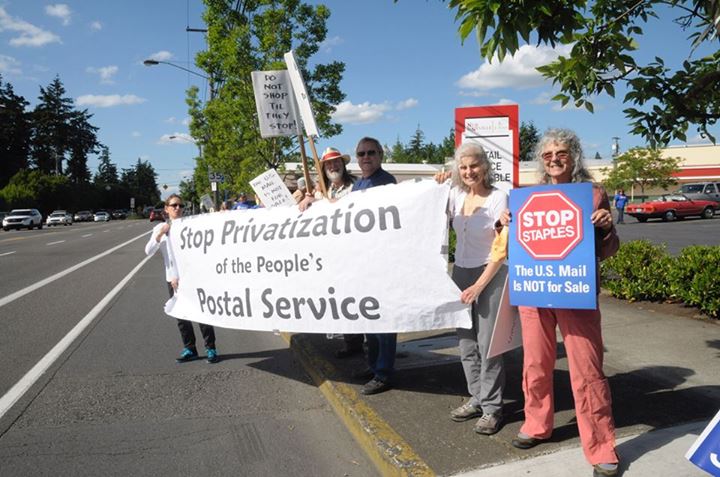
This work is licensed under a Creative Commons License
David Morris is Vice President and director of the New Rules Project at the Institute for Local Self-Reliance, which is based in Minneapolis and Washington, D.C. focusing on local economic and social development.
The truth about the US Postal Service
THE
BIG FAT LIE or the so-called "Postal Crisis" was caused by Congress in
2006. A few members of Congress have been pushing the idea that the
Postal Service is losing money -- actually, the US Postal Service has
been making money, but Congress has been using the Postal Service as a
cash cow, forcing it to pay billions into a "pre-funding" account (for
retirees who haven't even been born yet!) The Postal Service actually
has over $50 Billion dollars in the bank, but Congress won't let them
touch it. A campaign of lies has been fed to the American public.
The
leader in this misinformation campaign has been Rep. Darrell Issa,
Chairman of the House Oversight and Government Reform Committee, who
keeps throwing out the words "taxpayer bailout" to scare the public into
letting him push through changes to the post office that would
drastically reduce service by slowing mail delivery, eliminating one day
of delivery each week, and eliminating door-to-door delivery for 90% of
American homes and businesses. That's right, no more going to the
mailbox in your bunny slippers -- when you send Grandma a birthday card
or Uncle Fred gets his medicine in the mail, they will have to drive
somewhere to pick it up, or pay someone else a bunch of money to do it.
In
addition to slashing service, Issa's proposed "Postal Reform" would
force the layoff of thousands of postal workers throughout the country.
He says this is necessary to "save jobs."
Neither the internet
nor competition from UPS & FedEx are breaking the Postal Service.
Both UPS and FedEx use the US Postal Service to deliver many small
packages, because the Post Office can do it cheaper. In the same way,
delivery of small packages from internet sales has become a significant
part of Postal business.
If you care about having good mail service,
or even if you just don't like being lied to, please write your congress
people today. If you don't know who your representative is, you can get
the information at the following website: https://writerep.house.gov/writerep/welcome.shtml
As it turns out, a lot of members of Congress don't like being lied to either. Check this out: http://postalemployeenetwork.com/news/2012/02/congressman-hinchey-leads-111-h...
For more information about the "Postal Crisis", check out these websites: http://www.huffingtonpost.com/democracy-now/postal-service-reform_b_983279.html http://www.apwu.org/news/webart/2011/11-110-guffey-ed_show-110928.htm http://www.nalc.org/news/latest/12-7-2010-there_they_go_again.html http://www.youtube.com/watch?v=EUisfLtGN2A&feature=context&context=C4...
RALLY AND PICKET:
HOLD POSTMASTER GENERAL ACCOUNTABLE
Aug 21, 2012 07:30 AM
Vancouver Hilton 301 W. 6th Street, Vancouver, WA No Closures! No Cuts! Stop Delay of the Mail! The Postmaster General is speaking to everyday people doing business inside the Vancouver Hilton.On July 1st PMG Donahoe began massive closures and cuts to mail-processing plants and offices while changing delivery standards to delay first class mail. The postal service is not broke.
Congress manufactured a financial crisis and Congress or the President
will fix it. The PMG is unnecessarily, criminally obstructing and
delaying the mail in a misguided attempt to privatize this critical public communications service. The Alliance encourages putting postal professionals in charge of fully-funded and efficiently-staffed delivery services at all branches.
No fear, no compromise, and no surrender,
Courage, Commitment, & Community. LET YOUR VOICE BE HEARD!
DAY
THIRTEEN of Postal Road Warrior, rolling across Oregon in August --
Alsea, in the lush green of the Coast Range, a town of 1,500 (300+ rural
delivery, 250+ PO Boxes) with a full-service, full-time, feisty
postmaster and one HCR (highway contract route). Nicole, the fast
talking PM, was the center of tonight’s conversation, explaining in
excruciating detail to the ten assembled townspeople, the crazy US
Postal Service accounting system which put her post office on the
chopping block.
Never mind that revenues had doubled since she’d
been postmaster. Never mind that she’d gone out to customer’s homes to
develop ten new “Click and Ship” accounts and helped others understand
how to ship using EBAY. Never mind that she was credited one and a half
minutes to process a passpost applica
tion
or less than a minute per phone call. Never mind that she was expected
to keep up on all the new rules and regs, while waiting on customers,
dispatching mail and helping the HCR get out the door by noon.
I
fell in love with the group immediately, as they all clearly were ready
to engage the struggle -- including the young volunteer fire fighter,
the community newspaper mailer, and those who’d lived in Alsea
“forever”. The cries of “absurd” and “ridiculous” met my explanations
of the manufactured postal crisis. One old timer help bring the
conversation down to earth – “it’s all political, isn’t it?” A young
father seemed dubious -- “If we get enough people, the media, the
elected officials, we’ll win?” I could only assure that others had won
with people power, that the USPS greases the squeaky wheel. One oldster
had already been emailing and calling USPS district managers, with
fall-out bouncing back to the PM -- “What’s with your people; we never
hear from Alsea!” They’re pissed, she shot back.
When asked who was ready to fight, all hands went up…
A follow up to the "Occupy the Post Office" action in which ten people
were arrested just over a month ago. Communities and Postal
Workers United, Occupy Portland, Occupy St. Johns, and community
supporters rallied outside of the St. Johns central Postal Station in
north Portland. They were protesting the possible future closures of
some of 13,000 rural Post Offices as well as 25-30% cuts in pay and
losses of thousands of jobs.
This is part of a national campaign called "Save Americas Postal
Service", which is gaining momentum in several states and aims
to save Americas longest running civil service.
Our public postal service is under attack with the Postmaster General
poised to close 500 rural post offices while reducing hours from 25% to
75% at 13,000 rural post offices. On the chopping block are a number of
urban post offices, mail handling centers and Saturday
delivery. This is an example of shrinking public services so that they
can “be drowned in the bathtub.” Who will benefit? Privatizers and union
busters.
This September: Join Us on September 17th in New York City to Occupy Wall St
Coming in October:
Voices in Action: Human Rights on Film!
Sponsored by The Portland Alliance &KBOO: Progressive Community Resources
Alternative Choice in November: Green Party Nominee Jill Stein & Running Mate, Activist Cheri Honkala: "We Represent the 99 Percent"
Jill Stein's Vice-presidential running mate, Cheri Honkala, is a single mother
who has firsthand experience with homelessness. Honkala says. "Our campaign gives an
opportunity for people to see themselves, because we repreDsent the 99
percent." http://www.theportlandalliance.org/jillstein
It's "immoral that children are hungry and homeless in the richest country in the world," Honkala said. "It's time for the 99 percent to stand united to serve our collective
human needs instead of selfish, corporate greed," she said. "The Green Party is the only one standing up to Wall Street, and Jill
Stein's Green New Deal is the best plan for saving this sinking ship.
I'm honored to fight beside her.Fear-mongering and studious ignorance will not solve this crisis.
BREAKING NEWS AT THE ALLIANCE:
SYSTEM GRAVELY BROKEN: RESPONSES TO CHASSE DISCIPLINE REVERSAL
Yesterday, the news revealed that the two officers who had been disciplined in
the brutal beating
death of James Chasse, Jr. were ordered to have their
records expunged and back
payments made for the 80 hours each was suspended.